Rhino Husbandry Manual
Black Rhinoceros
Reproduction


Black Rhino Reproductive Age
The AZA Regional Studbook for Eastern black rhinos (Diceros bicornis michaeli) contains data on 154 (79.75) sires and dams and their 232 (128.100.4) calves, and the studbook database for South-central black rhinos (Diceros bicornis minor) contains data on 48 (17.31) sires and dams and their 78 (44.34) calves (Ferrie, 2022 and unpublished data). The youngest female South-central black rhino to give birth was five years eight months old, which means she conceived at four years two months of age. The youngest female Eastern black rhino to give birth was five years one month, which means she conceived at three years nine months. By comparison, in a 22-year old re-introduced black rhino population in South Africa, age at first reproduction was between six and nine years of age, with the age of first calving tending to increase with rhino density (Hrabar and du Toit, 2005). The oldest South-central female black rhino to give birth was 26 years eight months and the oldest Eastern black rhino female to give birth was 37 years 3 months. The youngest male Eastern black rhino to sire a calf was four years four months (at the time of conception) and the youngest male South-central black rhino was three years two months. The oldest to sire a calf was 36 years three months (Eastern) and 33 years two months (South-central). In general, black rhinos in human care can potentially reproduce between the ages of approximately four and 35 if they are maintained in good health, although a small number of births outside this range have occurred. Although fertility tends to decline in nulliparous females as they age, the oldest dam at first reproduction was 24 years and 2 months (Eastern) and the oldest sire at first reproduction was 25 years and four months (Eastern), suggesting that a few black rhinos can breed for the first time close to their median life expectancy. (Ferrie, 2025)
Seasonal Changes in Physiology Associated with Reproduction and Management Implications
The African black rhinoceros is not seasonally restricted in its breeding activity. Based on year-long fecal hormone metabolite analyses (Brown et al., 2001), it appears the captive female black rhino is consistently exhibiting reproductive cycles throughout the year, and hormone concentrations associated with the cycles do not differ by season. Although some of these cycles are anovulatory (Radcliffe et al., 2001), data are insufficient to determine if anovulation is seasonally influenced, and studbook data indicating that black rhinos produce calves every month of the year would argue against a strong seasonal effect on ovulation and conception. In contrast, results from fecal hormone metabolite research on wild southern black rhinos suggest that the females are more fertile during late spring and early summer, which corresponds to the early rainy season, and results in more females giving birth during the late rainy season when food is plentiful for lactating dams (Garnier et al., 2002). However, this apparent nutrient related seasonal skew in fertility is likely to diminish in captivity where high-quality food is available year-round.
Reproductive Cycle
The female black rhinoceros is a spontaneous ovulator with an average reproductive cycle length of ~26 days (Schwarzenberger et al., 1993; Berkeley et al., 1997; Brown et al., 2001; Radcliffe et al., 2001; Garnier et al., 2002). Although the black rhino appears to be more consistent in exhibiting regular reproductive cycles compared to Indian rhinos and white rhinos, there is some variation in cycle length with about 20% of the cycles being shorter than 20 days and 20% being longer than 32 days in length (Brown et al., 2001). The studies cited above have reported other variations in reproductive function, including anovulation, brief acyclic intervals and early embryo loss. The follicular phase of the cycle, when progesterone is at baseline concentrations, is relatively short, lasting three to five days (Brown et al., 2001). The black rhino preovulatory follicle is large, reaching ~5 cm in diameter and changing from spherical to pear-shaped just prior to ovulation (Radcliffe et al., 2001). Females ovulate 24 to 48 hours after estrus, and fecal progesterone increases about six days after ovulation (Schwarzenberger et al., 1993; Radcliffe et al., 2001).
Peak Breeding Season for Black Rhinos in North America
The mature captive, female black rhinoceros will breed throughout the year and calves have been produced in every month of the year with no particular bias for a specific season. The distribution of births by month for eastern black rhinos is shown in Figure 3.1 for the 199 births reported in the 2011 North American Regional Studbook (Christman, 2011). Figure 3.2 shows the months of conception based on an approximate gestation of 16 months. Similarly, Figure 3.3 shows the distribution of births by month for the 59 recorded southern black rhino births (Christman, 2011), and Figure 3.4 shows the associated months of fertile matings. These data demonstrate that eastern and southern black rhinos are fertile and conceive throughout the year. The trend towards more fertile matings in eastern black rhinos during the interval from March to September is almost certainly management related since temperate zoos are more likely to pair their rhinos for mating during months with good weather. Such a trend is not noted for the southern black rhinos, most of which are maintained in southern states like Texas and Florida. In the wild, an increase in the number of conceptions was associated with increased monthly rainfall in a re-introduced population in South Africa (Hrabar and du Toit, 2005).
Reproductive Monitoring
In general, black rhinos breed fairly well in zoos. Unlike the Asian species, the African rhino species typically are not dangerously aggressive when introduced for mating. Therefore, most animal care staff can simply introduce males and females when they observe estrous behaviors without a significant risk of animal injuries. However, reproductive monitoring can be very useful for pregnancy diagnosis and for determining if a female is still exhibiting reproductive activity when overt signs of estrus are not observed. Several hormones and their metabolites have been employed for monitoring reproductive activity in the African black rhinoceros (Table 3.7). Several studies have reported attempts to analyze urinary and fecal estrogen metabolites in black rhinos, but in most cases, results have been negative. Estrogen metabolites excreted by the Indian rhino accurately reflect reproductive status, whereas in the other rhinos species, only progesterone metabolite monitoring has proven useful for tracking ovarian activity.

Table 3.7. Reproductive Hormones Monitored in the African Black Rhino.*
Sample
Urine
Feces
Serum
Saliva
Estrogen
♀7 ♂2
♀1,3
♀1
♀5
Progesterone
♀2,7,8,10
♀ 1,3,6,9,11,12
♀1
♀5
Testosterone
♂2
♂3
♂4
* Table adapted from Roth, 2006.
1 Berkeley et al., 1997; 2 Brett et al., 1989; 3 Brown et al., 2001 ; 4 Christensen et al., 2009; 5 Czekala and Callison, 1996; 6 Garnier et al., 2002; 7 Hindle et al., 1992; 8 Hodges and Green, 1989; 9 Radcliffe et al., 2001; 10 Ramsay et al., 1987; 11 Schwarzenberger et al., 1993; 12 Schwarzenberger et al., 1996
Pregnancy Detection and Loss
In the black rhino, pregnancy can be detected early and monitored throughout gestation via rectal ultrasonography (Radcliffe et al., 2001). However, many black rhinos are not conditioned for ultrasound exams. Therefore, hormone concentrations in serum or hormone metabolite concentrations in feces are typically monitored to determine pregnancy status in the black rhino. Sustained elevations in progesterone concentrations four to eight weeks after mating is a good indicator of pregnancy (Schwarzenberger et al., 1993), but pregnancy can only be confirmed about three months after conception when progesterone concentrations increase above post-ovulatory luteal concentrations (Brown et al., 2001). Pregnancy loss, abortions and stillbirths have been reported in the black rhino, but the prevalence of stillbirths is much less than that for greater one horned rhinos. The first reported case of prescribing a progesterone supplement to help a rhino carry a pregnancy to term was in a black rhino (Berkeley et al., 1997). Since then, the synthetic progesterone, altrenogest (Regu-Mate®, Intervet Inc., Millsboro, DE), has been prescribed to additional black rhinos, Indian rhinos and Sumatran rhinos with confirmed histories of early pregnancy loss, and the anecdotal evidence suggests it is effective in helping to sustain pregnancies.
Reproductive Technologies (Semen Collection, Artificial Insemination, etc.)
Viable black rhino semen samples can be collected by electroejaculation (Roth et al., 2005), collection by catheter, or harvested from the epididymis post-mortem (O’Brien and Roth, 2000). Black rhino sperm obtained by either method withstand processing and cryopreservation procedures fairly well. Post-thaw functionality of frozen-thawed black rhino sperm has looked promising during in vitro fertilization studies (Stoops et al., 2011), but to-date, no calves have been produced with frozen-thawed black rhino sperm. Artificial insemination (AI) techniques have also been developed for the black rhino, and multiple AI attempts on multiple black rhinos have been conducted. However, to-date, no offspring have resulted from AI in the black rhino. In vitro fertilization has been attempted in black rhinos, but with limited success to-date. It has been possible to obtain oocytes from hormone-treated cows via transvaginal aspiration, and one four-cell embryo was produced following insemination of the oocytes with non-frozen semen (Hermes et al., 2009a). It has also been possible to rescue viable oocytes from the ovaries of cows post-mortem and several of these oocytes successfully matured in vitro with one two-cell embryo forming after insemination with frozen-thawed sperm (Stoops et al., 2011) . However, neither embryo produced by IVF continued to develop. This progress in rhino IVF is exciting, but also demonstrates that it is still in the very early experimental stages.
Sperm sorting to segregate X- versus Y-bearing sperm has also been conducted and appears to be possible in black rhinos (Behr et al., 2009; O’Brien et al., 2011). However, maintaining adequate sperm quality throughout the collection, transport, staining, sorting and cryopreservation process has proven challenging, and samples robust enough for AI have not yet been produced.
Fertility Assessment
Male fertility assessments should include: 1) an ultrasound examination of the testicles to evaluate tissue consistency and size, 2) electroejaculation to confirm sperm production, and 3) serum testosterone analysis. It is important to note that a positive result from electroejaculation is very meaningful, but a negative result should not be used alone to diagnose a male with infertility because electroejaculation is not always successful in producing good quality sperm samples, even when conducted on proven bulls.
Female rhinos should be examined by rectal ultrasound to determine if any masses or cysts exist in the vagina or uterus. These types of pathologies appear to be very prevalent in older Indian, white and Sumatran rhinos and much less prevalent in African black rhinos, but there have been a couple of reports of uterine or ovarian pathology in black rhinos (Godfrey et al., 1991; Hermes et al., 2009a). Ultrasonography can also be used to determine if the ovaries are active, however, any fertility assessment should include some form of longitudinal endocrine analysis which is more informative for assessing ovarian activity than a single ultrasound exam of the ovaries. These assessments can be conducted using serum or fecal samples (Table 3.7). Given the length of the black rhino reproductive cycle, samples should be collected and evaluated for at least 6-8 weeks.
Genome Resource Banking
A black rhino sperm bank already exists at the Cincinnati Zoo’s Center for Conservation and Research of Endangered Wildlife. Samples primarily include sperm rescued from the epididymis of testicles recovered post-mortem. A second black rhino sperm bank has been established at SeaWorld/Busch Gardens in San Diego and contains primarily electroejaculated samples, several of which have been sorted for X- and Y-bearing sperm. Fibroblast cell lines from many black rhinos are banked in San Diego Zoo’s Frozen Zoo, which also contains black rhino semen samples. Oocytes and embryos have not yet been banked and additional research is necessary before such efforts will be fruitful.
Challenges
Many zoos have been successful in breeding black rhinos, however there are some pairs that are behaviorally incompatible, or compatible and mating regularly without producing a pregnancy. These isolated cases can be a challenge. It appears that reproductive success in black rhinos is best if established, compatible, fertile pairs are allowed to remain at the same zoo and mate at fairly regular intervals (~3-4 yr).
Introductions
Factors that must be considered in any introduction include individual animal personalities, staff experience and confidence level, and enclosure type (i.e., indoor/outdoor, public/off-exhibit, relatively small/large). Barrier types and temperature should also be considered. Introductions often result in aggression, and it should be noted that rhinos of both sexes have been the aggressors. Territorial defense is often limited to ritualized confrontations, in which two rhinos advance toward each other but stop nose-to-nose and engage in a staring contest to gauge each other’s size and strength. Also as part of this ritual, the two individuals may touch horns, back apart and wipe their horns on the ground (Nowak, 1991).
More intensive conflicts involve head-on charges and inflicting injuries by horning or ramming. In general, behaviors that have been noted during rhino introductions are listed in Table 3.3. It is important to note that what is often perceived as serious or dangerous aggression between rhinos is, in fact, normal behavior requiring no intervention of any kind. Along with increased size and thick skin comes decreased vulnerability compared with many other animals. Table 3.4 lists a descriptive hierarchy of aggression levels in rhinos
Table 3.4. Levels of aggression in rhinos (Fouraker and Wagener, 1996).
Level of Aggression Definition
1 Rhinos are charging each other but do not make physical contact.
2 Rhinos are charging each other with physical contact resulting in some cuts and scrapes to the facial area.
3 Rhinos are charging each other with physical contact resulting in cuts and scrapes to the facial area and body.
4 Charging and/or pursuit proceeds to the point that one or both rhinos are knocked down at least once. Scrapes and cuts are deeper and more numerous.
5 Aggression and pursuit proceed to the point that one or both rhinos have subcutaneous wounds or arterial blood flow.
It should be noted that one animal might break away from the confrontation and attempt to escape. The aggressor often will pursue and begin horn-prodding the underbelly of the escapee as the two run around the enclosure. Often a rear leg is hooked and held aloft while pursuit continues. If the escapee does not stop and resume a defensive posture, the animals might continue until heat or exhaustion becomes a critical factor. Aggression at this point is more serious.
The introduction process requires much planning and cooperation among managers. Table 3.5 outlines recommended steps for rhino introductions. Familiarization through visual, olfactory and tactile contact should be permitted if at all possible prior to a full-scale introduction. If the facility permits, this may be accomplished by first placing individuals in the same barn or in nearby outdoor lots, or by providing olfactory cues such as urine, feces, or skin rubbings from the animal being introduced. As the animals acclimate, managers may move them to adjacent barred stalls or fenced outdoor yards. These barriers prevent confrontations leading to serious injury but allow acclimation and familiarization prior to introduction.
The actual introduction should be attempted in the largest available enclosure. Enclosures should be large enough to allow ample space for shading, mock-fighting, aggression and defense. The enclosure should contain visual barriers such as brush or earth piles or boulders (“run-arounds”), which give rhinos places to hide without becoming cornered or trapped.
These features may lessen overt aggression if a rhino is able to escape the sightline of another. An enclosure should not contain dead ends in which an individual may become trapped by an aggressor. The enclosure should allow for the use of high-pressure fire hoses, CO2 fire extinguishers and/or vehicles to aid in separating individuals.
Animal personality and disposition should always be considered in introductions. A subordinate animal should be introduced to a more dominant animal in an enclosure familiar to the subordinate. In the case of multiple-animal introductions (such as introduction of a new female to an established male-female group, discussed below), the most subordinate animal should be introduced to the next most subordinate, and so on up the dominance hierarchy. Greater aggression may be noted in some individuals in the presence of an estrous female; therefore, any introduction attempt at this time should be especially well-monitored or possibly avoided if the attempt involves a male.
Table 3.5 Steps of an Introduction
Step Description
-
Animals in the same barn or multiple outdoor lots should have olfactory and auditory exposure to each other. If the animals are not housed near each other (i.e., enclosures on opposite sides of the zoo, etc.), they should be moved to the same exhibit area.
-
Animals should be given visual contact with each other in addition to the above sensory modalities. Animals may be shifted within a barn or in adjacent outdoor lots. If at any point during this process the animals display symptoms associated with stress (e.g., pacing, diarrhea, excessive vocalizations) for more than 2-3 hours, the introduction should return to the previous step.
-
If animals are not already positioned adjacent to each other, they should be moved closer together (e.g., to adjacent stalls or adjacent outdoor enclosures).
-
The actual introduction (full tactile exposure) should take place in the largest enclosure available and follow guidelines stated in this chapter. Preferably, the enclosure should be familiar to the least dominant animal and include ample “run-arounds”.
-
Within institutions in which rhinos can be left together 24 hours per day, they should be separated during the first several nights or until they show only minor aggression.
2 Weeks Prior to Birth
-
Nipples enlarge,
-
Nipples develop wax.
-
Vulva swelling occurs.
30 Days Prior to Birth
-
Increase in teat size.
-
Beginnings of milk production.
-
Milk may be expelled with pressure on teats.
-
Female may prolapse vaginally with defecation.
Appropriate personnel for first-time introductions include the primary animal manager, a vet with immobilization equipment, and the curator and keepers most familiar with rhinos. Other staff also may be needed at critical points around the enclosure’s perimeter so that the animals may be observed at all times in case separation becomes necessary. It should be noted that if a barn is opened and used to separate individuals, only one individual should be allowed inside the barn, and it must not be trapped inside by an aggressor.
The social nature of the black rhinoceros is intermediate between that of the white and greater one-horned species. In general, a 1.1 pair is the recommended group size. Additionally, in comparison with the other rhino species, black rhinos have a much longer average birth interval. In an effort to decrease this interval and re-breed females earlier, a female black rhino should be temporarily reintroduced to the male for breeding following her first post-partum estrus (see calf development below for separation periods). Following are recommended protocols for potential black rhinoceros introduction types.
Introduction of a New Male to a Female (or Vice Versa) to Form a Pair
The introduction should occur in the largest lot available, following the general introduction protocols above. If a single large lot is not available, adjoining lots should be opened to form a large area for the introduction. If the latter strategy is used, care should be taken to modify any resulting dead ends in the exhibit where a rhino may become trapped during an aggressive interaction. If all yards are the same size, it is best to introduce in the subordinate’s yard, usually, but not necessarily, the female’s yard.
Introduction of a New Female to an Established Male-Female Group (if adequate space is available)
Unlike white rhinos, female black rhinos generally do not tend to form strong pair bonds.
Therefore, a new female should be introduced to an established male-female group one individual at a time, but it is not necessary that she be introduced to all females before being introduced to the male. For breeding introductions, a calf should be trained to be temporarily separated from its dam so that she can be introduced to a male (see calf development, this chapter).
Introduction of a New Male to an Established Female Group (if adequate space is available)
As stated above, female black rhinos do not generally tend to form strong pair bonds.
However, if a multiple-female group is established and managers perceive that the females have formed strong bonds, the new male should be introduced to the females as a group rather than to one female at a time. If the females are not as compatible as managers would like but an introduction is necessary (SSP recommendation, breeding, etc.), the new male should be introduced to each female individually. Following all successful male-female introductions, the male should be introduced to all the females at the same time.
Reintroduction of a Post-partum Female (Without Calf) to a Male
The reintroduction of a post-partum female to a male is usually recommended for the cow to be re-bred. Therefore, this type of introduction is usually temporary, and following breeding, the female should be placed back with the newborn calf. In order to attempt this introduction, the calf must be trained to be separated from the female (see calf development, this chapter). The introduction of the port-partum female to a male should be attempted following the first post-partum heat.
Pregnancy and Parturition
Table 3.6 lists behaviors associated with pregnancy and impending birth. Black rhinos may breed continually throughout gestation. In all species, there may be a mucus discharge, noticeable weight gain or increase in girth size, as well as increased frequencies of defecation and urination throughout gestation. Pregnant black rhino females have been observed isolating themselves from other individuals. If pregnancy is confirmed (pregnancy fecal hormone tests are available, or through ultrasound), and/or the breeding date is known, the physical separation of the pregnant
female from the bull/herd should take place as early as 30 days and as late as 24 hours prior to birth. Institutions with very large enclosures have had successful births in the yard with the male present; however, the female(s) and any males must be watched very closely.
Table 3.6. Physiological and behavioral indicators of impending parturition.
24 to 48 Hours Prior to Birth
-
Udders increase dramatically in size.
-
Inappentance.
-
Mucus plug forms.
-
Become irritable and aggressive to stimuli (including staff).
-
Increased vulva dilation.
-
Increased restlessness.
The onset of labor often takes place at night or in the early morning and may last one to three hours. Parturition usually lasts ten to 12 hours from breaking of the water, though first-time mothers may take longer to calve. The presentation of a calf is generally head-first, although rear- feet presentations do occur and may take longer than head-first births, but usually deliver without assistance. Capabilities for monitoring births remotely through closed-circuit television or other means are advisable.
Calf Development
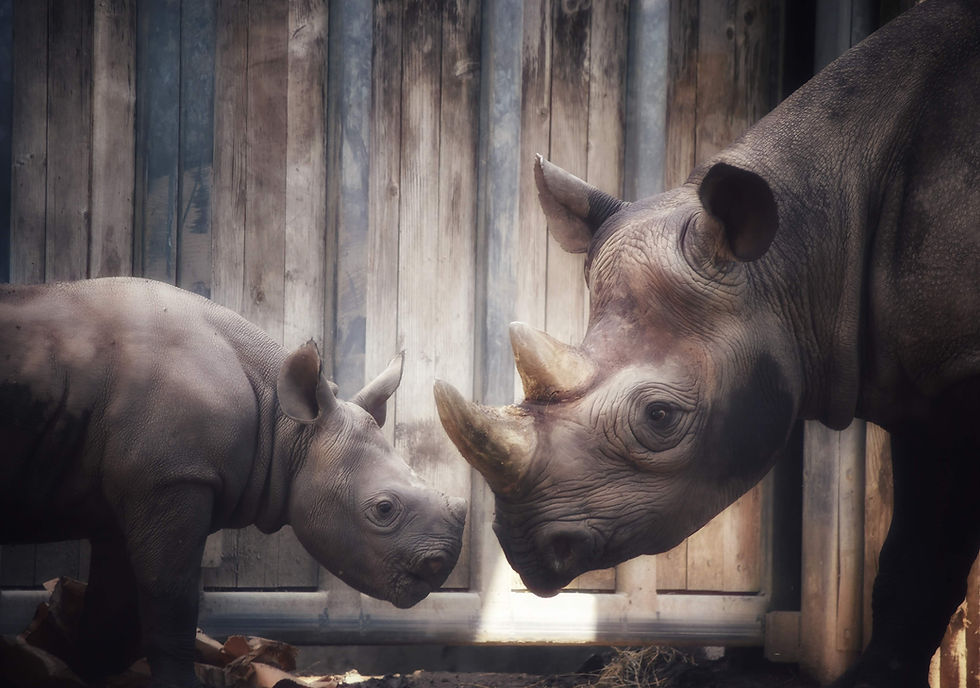
A single calf is generally the rule. Few data are available on birth weights, but in general, calves weigh 27 to 41 kg (range=60-90 lb. n=4). Immediately following birth, the newborn calf is usually cleaned by its mother and stands for the first time within 30 minutes to five hours of birth. A newborn calf may require a substrate that allows traction to help steady it. Suitable materials may include sand, gravel, straw, hay or rubber matting. In all cases, both the cow and calf should be monitored closely to prevent ingestion of the substrate. A calf should begin nursing within one to two hours of standing (though in a single case, a calf removed from its dam for medical intervention nursed 16 hr. post-birth). The cow will nurse her calf while standing or lying on her side.
Infants less than two months old may nurse hourly, while older calves nurse at intervals of about 2.5 hours. Few data are available on nursing durations and frequencies, but it has been reported that as the calf ages and grows stronger, nursing will usually increase in duration but decrease in frequency. It has been reported that calves may gain up to 4.54 kg (10 lb.) per day for the first ten days. The first defecation has been reported at two to ten days of age (n=2). Calves may nurse for up to two years, although they have been observed first sampling solid food at less than one week to one month of age. Calves may be offered supplemental feedings of milk if the cow is believed to be a poor milk producer or the calf is not gaining weight (see Nutrition chapter). Infant rhinos have been successfully pulled from their mothers because of rejection, medical issues related to the mother or infant, or from a failure to nurse. Otherwise, it should be noted that weaning for management purposes can be accomplished if necessary at six months, but one year is preferable.
One attempt to use a surrogate mother was unsuccessful; however, hand-reared infants have been assimilated into existing groups and have shown reproductive success. Keeping the calf with the cow even longer helps to facilitate social learning. Male calves are usually weaned by the cow at an earlier age than female calves. Depending on the facility, a cow and her newborn calf may be reintroduced to the male/herd following the cow’s first heat. Calves generally do not have peers to play with, though they are generally very curious and often chase and mock-fight with their dams
or occasionally keepers. Non-aggressive sexual behaviors may be exhibited at as early as 18 months of age in males.
In general, the long-term social effects of removing rhino calves from dams should be investigated. For all species, weaning or permanent separation of the calf except for medical reasons should not occur before one year of age. A calf can, however, be temporarily separated from its mother at as early as one month of age for short periods of time (e.g., re-breeding of dam). Generally, the procedure is to separate the calf for short periods of time (e.g., 15-20 minutes during cleaning) and gradually increase the separation time. If a cow is not going to be re-bred, her calf may remain with her until it reaches sexual maturity (at approximately 4.5-5 yr. of age). It should be noted that available data indicate that nursing does not inhibit conception. The first calf may be forced away before parturition of the second calf as the cow seeks to isolate herself.



Seasonal Changes in Physiology Associated with Reproduction and Management Implications
The African black rhinoceros is not seasonally restricted in its breeding activity. Based on year-long fecal hormone metabolite analyses (Brown et al., 2001), it appears the captive female black rhino is consistently exhibiting reproductive cycles throughout the year, and hormone concentrations associated with the cycles do not differ by season. Although some of these cycles are anovulatory (Radcliffe et al., 2001), data are insufficient to determine if anovulation is seasonally influenced, and studbook data indicating that black rhinos produce calves every month of the year would argue against a strong seasonal effect on ovulation and conception. In contrast, results from fecal hormone metabolite research on wild southern black rhinos suggest that the females are more
fertile during late spring and early summer, which corresponds to the early rainy season, and results in more females giving birth during the late rainy season when food is plentiful for lactating dams (Garnier et al., 2002). However, this apparent nutrient related seasonal skew in fertility is likely to diminish in captivity where high-quality food is available year-round.
Reproductive Cycle
The female black rhinoceros is a spontaneous ovulator with an average reproductive cycle length of ~26 days (Schwarzenberger et al., 1993; Berkeley et al., 1997; Brown et al., 2001; Radcliffe et al., 2001; Garnier et al., 2002). Although the black rhino appears to be more consistent in exhibiting regular reproductive cycles compared to Indian rhinos and white rhinos, there is some variation in cycle length with about 20% of the cycles being shorter than 20 days and 20% being longer than 32 days in length (Brown et al., 2001). The studies cited above have reported other variations in reproductive function, including anovulation, brief acyclic intervals and early embryo loss. The follicular phase of the cycle, when progesterone is at baseline concentrations, is relatively short, lasting three to five days (Brown et al., 2001). The black rhino preovulatory follicle is large, reaching
~5 cm in diameter and changing from spherical to pear-shaped just prior to ovulation (Radcliffe
et al., 2001). Females ovulate 24 to 48 hours after estrus, and fecal progesterone increases about six days after ovulation (Schwarzenberger et al., 1993; Radcliffe et al., 2001).
Peak Breeding Season for Black Rhinos in North America
The mature captive, female black rhinoceros will breed throughout the year and calves have been produced in every month of the year with no particular bias for a specific season. The distrbution of births by month for eastern black rhinos is shown in Figure 3.1 for the 199 births reported in the 2011 North American Regional Studbook (Christman, 2011). Figure 3.2 shows the months of conception based on an approximate gestation of 16 months. Similarly, Figure 3.3 shows the distribution of births by month for the 59 recorded southern black rhino births (Christman, 2011), and Figure 3.4 shows the associated months of fertile matings. These data demonstrate that eastern and southern black rhinos are fertile and conceive throughout the year. The trend towards more fertile matings in eastern black rhinos during the interval from March to September is almost certainly management related since temperate zoos are more likely to pair their rhinos for mating during months with good weather. Such a trend is not noted for the southern black rhinos, most of which are maintained in southern states like Texas and Florida. In the wild, an increase in the number of conceptions was associated with increased monthly rainfall in a re-introduced population in South Africa (Hrabar and du Toit, 2005).
Reproductive Statistics

