Rhino Husbandry Manual
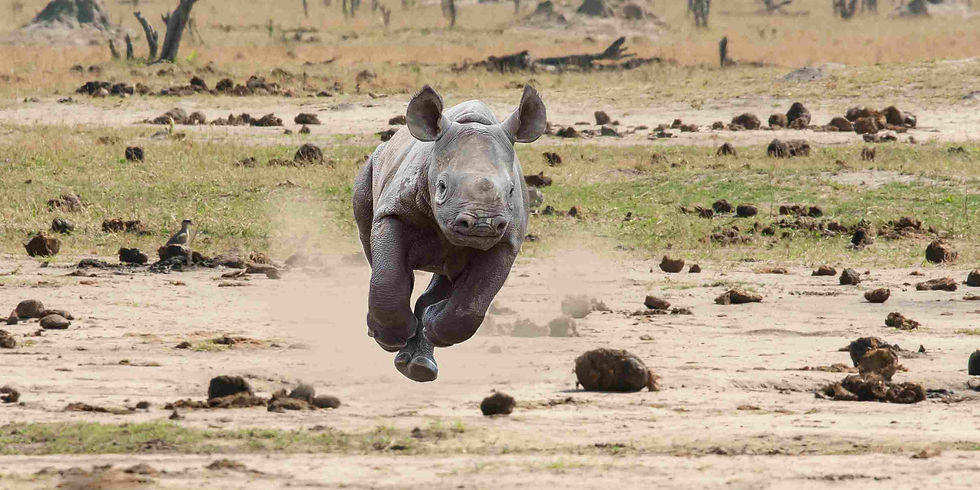
Black Rhinoceros
Behavior
Ranging Behavior and Sociality
Black rhinos primarily are browsers, so they may roam long distances (>500 km2; >123,553 acres) in search of food and water in arid habitats (Hutchins and Kreger, 2006). Home range sizes (6.8-235 km2; 1,680-58,070 acres) and core areas (0.6-74 km2 ; 148-18,286 acres) can be highly variable depending on habitat type and duration of occupancy (Tatman et al., 2000; Lent and Fike, 2003; Göttert et al., 2010), and they might also shift in size and position over time (Lent and Fike, 2003; Göttert et al., 2010). Female home ranges do overlap, especially in areas with preferred forage (Tatman et al., 2000; Lent and Fike, 2003; Göttert et al., 2010). Wild female and subadult black rhinos might be observed in small groups on occasion, but these are usually transient (OwenSmith, 1988; Hutchins and Kreger, 2006; Göttert et al., 2010). Cows with calves tend to stay alone; however, the twosome sometimes allow an unrelated immature male or female to join them until that individual reaches maturity (Goddard, 1967).
Black rhino males often occupy and defend mutually exclusive territories in southern Africa (Owen-Smith, 1988), but they might occupy undefended, overlapping home ranges (Owen-Smith, 1988) or non-overlapping home ranges (Tatman et al., 2000) in East Africa. Males (n=2) in South Africa did not establish their territories until approximately age nine, and “satellite males” up to seven or eight years of age roamed within the territory of an older male (Lent and Fike, 2003). It is likely that variability in male spatial distribution across populations and over time is affected by vegetation type and structure, climate, and female spatial distribution. Territory and home range boundaries are delineated by scent marks left by males during spray-urination, dung-kicking, scraping with the fore- and/or hindlegs, and horn-scraping (Table 3.25; Owen-Smith, 1988). Both in the wild and in managed settings, male and female rhinos defecate almost exclusively at communal dung piles, and these dung piles are distributed over the entire home range, but especially near paths and water sources (Tatman et al., 2000).
Injuries from fighting among unfamiliar rhinos were more likely when male and female black rhinos were translocated into reserves ≤11,500 ha with densities of ≤9 km2 (2,224 acres) per rhino compared to those ≥18,000 ha (Linklater and Swaisgood, 2008). Given larger space, encounter rates were lower and the rhinos could become familiar with one another more gradually and with less injurious aggression. A large-scale analysis of more than 600 translocations demonstrated that younger rhino, especially dependent calves, were most vulnerable and had lower survival rates, especially when introduced into an existing population (Linklater et al. 2011, 2012). These studies have implications for introductions in zoo facilities. Aggression is much rarer when animals are familiar with one another, and unfamiliar animals should be introduced gradually and in the largest space possible. Extra precaution should be taken when young animals are involved.
Table 3.25 Ethogram to assist with general rhino management (adapted from Fouraker and Wagener, 1996).
General Behaviors Definition
LOCOMOTE
RESTING
WALLOW
FORAGE
OBJECT TOSS
HORN RUB
HEAD SWEEP
MOUTHING
NURSE
Move about covering ground.
Recumbent on the ground.
Roll, lay down, or move about in an area that id wet or muddy.
Search for consume food.
Tilt or lift inanimate object off the ground.
Rub horn against an object; often occurs when horn is wet.
Head swings laterally relative to the ground, rooting the air with the horn.
Repeated chewing or gumming motion with mouth open; not associated with eating.
Calf becomes still and suckles, Tail may wag.
Elimination behaviors Definition
URINATE
DEFECATE
HIND FOOT KICKING
HING LEG DRAG
URINE SPRAY/SQUIRT
URINE FECES INVESTIGATION
DEFECATION ON PILE
Discharge or pass urine in a stream.
Discharge fecal material.
Rapid alternation of hind feet against ground while remaining stationary; often associated with male eliminations.
Walk with hind legs stiff and straight producing a scrape mark on the ground (usually performed by male during scent marking or urine spraying).
Project urine in a strong spray (usually male) or distinct squirts (female); may be directed on substrate.
Smell or taste urine pool or feces; often with flehmen.
Defecate on an area that has been used repeatedly as dung pile.
Social Behaviors Definition
PROXIMITY
FACE TO FACE STARE
AFFILIATIVE PHYSICAL CONTACT
FOLLOW
CHARGE
CHASE
OPEN MOUTH THREAT
Rhinos are within one body length of each other.
Rhinos stand less than one body length from and facing ech other.
Touch, rub, or lick other animal.
Locomote to remain within close proximity of another animal.
Locomote rapidly toward another animal with head lowered.
Locomote rapidly in pursuit of another animal.
Display in which one rhino faces another with open mouth and bellowing; also associate with charge/chase behavior.

Reproductive Behavior
Black rhino males are polygynous, and only a few males in a wild population might sire most of the offspring (Garnier et al., 2001). Subadult males and less preferred mates do not associate with female black rhinos during their fertile period (Garnier et al., 2002). Reproductive behavior in wild black rhinos lasts up to four days (Garnier et al., 2002), during which the female might mate with several bulls (Estes, 1991). Multiple mountings by the male will occur before copulation takes place (Tables 3.25 and 3.26; Hutchins and Kreger, 2006). Black rhino males might mount with or without an erection (Fig. 3.14; Fouraker and Wagener, 1996). At full copulation, rhinos may remain coupled for 30 minutes to one hour, with ejaculations every few minutes (Fouraker and Wagener, 1996). Interestingly, black rhinos may breed continually throughout gestation (Fouraker and Wagener, 1996).

Fig. 3.14. The male usually mounts the female multiple times with and without an erection before successful copulation finally occurs (courtesy of K. Meeks, White Oak Conservation).
Parturition usually lasts ten to 12 hours from water-break, though first-time mothers may take longer to calve (Fouraker and Wagener, 1996). Black rhino females do not tolerate the presence of other rhinos during, and for a few months after, the birth of a new calf (Hall-Martin and Penzhorn, 1977). Infants may nurse hourly while older calves nurse every couple of hours (Fouraker and Wagener, 1996). It has been reported that as the calf ages nursing will usually decrease in frequency (Fouraker and Wagener, 1996). Wild, newborn black rhinos may remain in hiding during their first week to month of life (Hall-Martin and Penzhorn, 1977; Hutchins and Kreger, 2006), and freeranging mothers will move as far as 19 km (11.8 mi) from their young calves (< 6 months of age) when traveling to water (Berger, 1993). In zoos, calves might be expected to remain close to their mother 75% of the time during the first six weeks of life (Greene et al., 2006). Calves (n=5) might be expected to spend about ~55% of their time resting, ~15% of their time playing, ~10% of their time standing, ~10% of their time locomoting, and ~5% of their time nursing (Greene et al., 2006).
Mothers spend most of their time resting (~40%) or standing (~30%) and less time feeding (~20%) or locomoting (~10%)(Greene et al., 2006). Possibly owing to their more solitary tendencies and reduced space availability in zoos, captive females will calve for the first time at a younger age when they are the only female at a given zoo, and reproductive rate is higher when there are fewer females at a zoo (Carlstead et al., 1999a).
Greater amounts of aggressiveness and assertiveness by a female were found to contribute positively to zoo-housed female black rhinos’ chances of breeding, and higher reproductive success also was found in black rhino females that were more dominant than the male (Carlstead et al., 1999a,b). Male black rhinos express their dominance less when housed in a larger enclosure, thus large enclosures that reduce dominant, aggressive behaviors in the male might promote greater breeding success (Carlstead et al., 1999a). Black rhino females that scored lower on stereotypical behaviors also tended to have greater breeding success (Carlstead et al., 1999b), and monitoring changes in these behavioral frequencies (chasing, mouthing, and stereotypical behaviors) as an indicator for reproductive performance was recommended (Carlstead et al., 1999b).
Table 3.3 General reproductive behaviors observed during estrus and courtship (Fouraker and Wagener, 1996)
Female Behaviors Male Behaviors
Vocalizations* Vocalizations
Urine squirt/spray* Frequent urination; urine spray
Urogenital changes (e.g., vulva swelling) Erection
Vulva “winking” Genital inspection of female
Vaginal discharge* Flehmen response
Aggression toward male** Charge/chase female
Maintains proximity to male Maintains proximity to female
Nuzzles male’s belly and/or genitals Follows female
Stands for male Chin-rest
Inappetance Mounts female
*Estrous behaviors in the absence of a male are often difficult to distinguish. In general, increased activity, agitation, vocalizations, spray-squirting urine, and vaginal discharge have been cited. As the female approaches peak estrus, these behaviors usually increase in frequency. Some females have been reported to successfully breed without exhibiting any overt behavioral signs of estrus
In order to conduct appropriate behavioral studies, many institutions have utilized ZooMonitor.
-
ZooMonitor is an app developed by Lincoln Park Zoo that allows you to record animal behavioral data, visualize the information, and export the data for analysis. When designing ZooMonitor, the goal was to make it easy for experts and non-experts alike to collect data that will aid in making and evaluating management decisions that impact animal welfare.
-
ZooMonitor was made possible in part by the Institute of Museum and Library Services MG-30-14-0045-14, and is free to download for qualifying institutions.

Adolescent Black Rhinos
In the wild, dispersal of two male calves occurred at three to four years of age. In contrast, females continued to maintain a home range overlapping that of their mother into adulthood, and disassociations were usually temporary following the birth of a new calf (Lent and Fike, 2003). If a cow and calf are separated from other rhinos at zoological institutions, they may be reintroduced following the cow’s first estrus (Fouraker and Wagener, 1996).
Behaviors Specific to Zoo-Managed Rhinos
A common behavioral abnormality observed in zoo-managed rhinos is excessive horn rubbing (Hutchins and Kreger, 2006), which might indicate boredom or distress, e.g., when rhinos are housed indoors without activity or forage (Dieckhoefer et al., 2006). Stereotypical behaviors among female black rhinos were associated with a greater percentage of wall space over which the rhino could not see, whereas males’ stereotypical behavior was positively correlated with chlorine use (Carlstead et al., 1999a), possibly because it masks or removes their own scent marks. Males that scored higher for “fear” were housed at facilities where there was a greater percentage of outdoor enclosure perimeter that allowed zoo visitors to have unobstructed view into the enclosure at a distance of less than 10 m (32.8 ft)(Carlstead et al., 1999a). This finding is not unexpected given the observation that wild black rhinos choose bedding sites enclosed by tall vegetation and dense thickets (Tatman et al., 2000), suggesting this species prefers the security offered by cover. Fighting among zoo-housed black rhinos was associated with variability in glucocorticoid metabolites, which are secreted during the adrenal stress response (Carlstead and Brown, 2005).
Behavior During Introductions (from Fouraker and Wagener, 1996)
Aggression between newly introduced black rhinos can be severe, especially if a new rhino(s) is being introduced to an established rhino(s) (Hall-Martin and Penzhorn, 1977). Thus, a “howdy” period and plenty of space for escape upon the first physical introduction is highly advisable. Rhinos of both sexes have been the aggressors. Behaviors that have been noted during rhino introductions are listed in Table 3.27. Territorial defense is often limited to ritualized confrontations, in which two rhinos advance toward each other but stop and engage in a horn to-horn stare (Tables 3.25 and 3.27). Also as part of this ritual, the two individuals may touch horns, back apart, and wipe their horns on the ground (Nowak, 1991). More intensive conflicts (Table 3.28) involve charges and inflicting injuries by horning or ramming. It is important to note that what is often perceived as serious or dangerous aggression between rhinos is, in fact, normal behavior requiring no intervention of any kind. Along with increased size and thick skin comes decreased vulnerability compared with many other animals. In some cases, aggression may proceed to a point at which management should intervene to prevent serious injury. Rhino managers should allow some aggression during an introduction but be prepared to intervene in the event that aggression threatens the lives of one or more animals. Protocols for intervening may vary across institutions, but in general, careful consideration should be given to intervening in an introduction before aggression reaches Level 5 (Table 3.28). Stopping an introduction at a level prior to this will not lessen aggression during a subsequent introduction attempt. Animals that are allowed to “settle their differences” will establish some territorial boundaries and usually will not engage in serious aggression again, with the exception of a male attempting to approach an estrous female. In sum, moderate aggression is commonplace in any rhino introduction; sparring and fighting will occur and result in minor injuries (cutaneous wounds). However, in most cases, aggression levels prior to Level 5 may be allowed to continue using the discretion of management. Animal personality and disposition should always be considered in introductions. A subordinate animal should be introduced to a more dominant animal in an enclosure familiar to the subordinate. In the case of multiple-animal introductions, the most subordinate animal should be introduced to the next most subordinate, and so on up the dominance hierarchy. Greater aggression may be noted in some individuals in the presence of an estrous female; therefore, any introduction attempt at this time should be especially well-monitored or possibly avoided if the attempt involves a male. Aggression may be meaningfully reduced by allowing individuals to become familiar with each other through protected contact (e.g., through enclosure bars) or, possibly, by exposing them to one another’s odors for a period prior to introduction.