Rhino Husbandry Manual
Greater One Horned Rhinoceros
Indoor Enclosure


Indoor Housing
Indoor housing is recommended for additional separation capabilities (beyond the primary enclosure) and is critical for those institutions in colder latitudes. At no time should rhinos be forced to endure temperatures below freezing for any length of time; animals may go out for short periods when temperatures are below freezing, but they should have access to radiant heat or heated enclosures during these times. An indoor facility in the winter should be heated to a minimum of 13°C (55°F) with the capability of maintaining some areas of the barn at 23.9°C (75°F). Supplemental heat may be needed when dealing with infants or with sick or older animals. Some acclimation may be necessary before moving animals from a warm barn to the outdoors during winter months. The humidity level should be maintained at 40 to 70%. Shower sprays or water baths should be offered in areas of relatively low humidity. Indoor facilities should be maintained with a negative air pressure, and ventilation should be provided to accommodate at least four air exchanges per hour (USDA recommendations for a cold-weather heated barn). Institutions are encouraged to check with their local authorities for air-exchange requirements when the public or personnel occupy the facility.
Within any indoor facility, areas must be provided for food and water. Fresh water should be available at all times and should be changed daily or be supplied from an automatic-fill or continuous-flow device. Regular cleaning and disinfecting should occur at a rate that inhibits the growth of algae and bacteria. Water devices should be constructed to prevent upset, spillage or leakage.
For greater one-horned rhinos, isolated stalls are essential. The indoor enclosure should include a minimum of 30 sq m (320 sq ft) per animal for greater one-horned rhinos (Table 4.12). An additional 50% of adult space should be provided when a calf is present. This may be achieved by using more than one stall. Following weaning, a calf should be treated as an adult individual with respect to space requirements. If the institution has only indoor facilities in which to maintain and/or exhibit rhinos, the minimum requirement is 186 sq m (2,000 sq ft) per rhino [15.2 x 12.2 m (50 x 40 ft)] plus the recommended indoor holding [30 sq m (320 sq ft) per individual for greater one-horned rhinos].
Separation Capabilities
The indoor facility should have the capacity to separate individuals for a variety of purposes. As indicated above, greater one-horned rhinos should be kept in individual stalls. The facility should also have an extra space or large stall to make it possible to isolate mothers and calves or quarantine sick animals. Currently, no quantitative data are available on the visual, olfactory or auditory capabilities of rhinos in relation to breeding success. Based on species ecology and behavior, however, it is believed that rhinos rely heavily on both olfactory and auditory senses for social communication. It is therefore recommended that indoor facilities allow these types of communications at certain times among individuals. Options include partial walls or pipe fencing to allow for physical separation without visual, auditory or olfactory separation.
Substrate and Special Features
According to EAZA Best Practices manual (2015) "The surface is the most important issue when keeping greater one-horned rhinoceroses. It needs to be nonabrasive. Given the fact that the animals will spend a lot of time in the stable, this issue needs good considerations. Some zoos tried rubber (mats as well as pour-on rubber). The experience with both materials (especially with the pour-on rubber) showed poor results. Abrasions still occurred. (For more details on foot problems see vet. chapter). The best experience so far was made with a deep 50cm layer of wood chips. Attention should be paid not to use wood from pine trees or other trees which contain etheric oils. Those can cause skin rash. Brushed concrete is not recommended to be used for greater one-horned rhinos."
Normal light cycles seem to be adequate for rhinos. However, if an animal is to be held indoors for more than 12 hours (e.g., winter at cold-climate institutions), artificial or natural light sources to simulate natural cycles should be provided. Fluorescent lighting is an efficient light source that provides broad-spectrum illumination. Skylights should also be included whenever possible. Additionally, because greater one-horned rhinos are introduced for breeding purposes for a limited amount of time and closely observed, lighting is also necessary in outdoor enclosures for the observation of breeding at night.
Any new exhibit should include the capability for video systems. In addition, a scale for weighing animals is desirable and strongly recommended. Vehicle access to an indoor facility is also recommended. A restraint device or an area for restraint should be included in the design of every facility, as well as an area to set up crates for training, loading, and unloading.
Physical Restraint Designs
Numerous institutions have constructed permanent physical devices to restrain their rhinos when necessary. Such “chutes” can be very valuable for physical exams as well as nutritional, reproductive or veterinary research. In addition to the following general information, please consult the Health chapter of this publication as well as Schaffer (1993) and Eyres et al. (1995). Institutions in the United States that currently have chutes and may be able to provide additional information include Henry Vilas, Saint Louis, Sedgwick County, Oklahoma City, Henry Doorly, Cincinnati, Caldwell, and Milwaukee County Zoos, Fossil Rim Wildlife Center, and the Wilds. Companies that may assist in chute design and construction include Animar Systems, Inc. (Springfield, MO, USA), Cummings and Son, Inc. (Garden City, KS, USA), Mark McNamara of Fauna Research (Tamer, Fauna Research, Inc., Red Hook, NY, USA). In general, institutions modifying rhino exhibits or constructing new ones should incorporate a physical restraint area or device into their design.
Several physical restraint designs are effective for rhinos. These range from a small restricted area in which to contain the animal to an area that contains one or more hydraulics that will “squeeze” together to restrict an animal’s movement. In general, major restraint chute design considerations include strength, durability, type and function. It should be noted, however, that available space and animal size and disposition vary across institutions and should be individually addressed.
In general, both zoo managers and researchers emphasize that the general restraint area should be an active component of daily rhino management. Methods to accomplish this vary. A restraint chute or restraint area can be designed so that the rhinos must pass through it to exit the barn into their yard. If rhinos are fed indoors, part of the feed (e.g., produce, grain) can be offered in the chute area. Finally, more extensive conditioning (see Training chapter) can be particularly effective in habituating rhinos to physical restraint. Such a program should be attempted prior to detaining a rhino in a chute for an exam.
Rhino chutes should be manufactured out of steel or a combination of steel and steel-reinforced wood. Some institutions have also used steel-strength aluminum (6061-T52 aluminum). Aluminum of this type is lighter and more maneuverable than steel, as well as potentially less stressful to rhinos because of “deader” sound properties than steel (i.e., when metal scrapes metal).
Permanent pass-through indoor restraint chutes (similar to those constructed for elephants) are especially effective for rhinos. With training, this type of chute may allow for detailed daily rhino observations. Further, inclement weather will not affect the use of an indoor restraint chute. The chute should allow restraint of the animal when it is passing through in either direction so that the shifting routine of the animal is not interrupted (Schaffer, 1993). The width of the chute should limit side-to-side movement while still allowing the animal to comfortably lie down. Animals can become wedged in tight-fitting chutes if the sides cannot be released. To alleviate excessive forward movement of the animal when it lowers its head, two vertical bars that push in from the sides of the chute to the shoulders of the rhino may be utilized. Quick release of these shoulder bars often relieves agitated animals without having to release them completely.
High-walled chutes or bars over the top of the chute keep the animal from climbing or rearing up. Horizontal bars in the chute’s entry gates and sides are hazardous for examiners when the animal lies down. Vertical bars on the sides can trap researchers’ arms if the animal can move forward. If the animal’s forward and side-to-side mobility can be limited, vertical bars or walls on all sides are recommended. The distance between these bars along the sides of the chute should be great enough to prevent the animal’s foot from becoming wedged if the animal rolls on its side in the chute. For personnel safety, this distance can be divided with removable vertical bars.
Rhinos may slam swinging doors; thus, sliding or guillotine gates are safer. A rectangular opening in these gates for performing palpation should not pin the arm of an examiner when the animal is shifting. The distance between the vertical sides of this rectangular opening must be wide enough to provide for staff safety while still limiting the space through which a rhino could squeeze. Also, the horizontal bottom bar of this rectangle should be only a few inches from the ground, as animals frequently lie down. Solid doors on the outside of these gates can be used to stop rhinos, as they may attempt to charge even small openings. Additionally, good lighting and accessible electrical sources are useful.
A closed chute (Fig. 3.6) is another option that has been used successfully for the treatment of a rhino with a urinary-tract infection and another with infected lesions on its foot (Eyres et al., 1995). As noted in Figure 3.6, a typical closed chute has both front and back gates. The back gate restricts the rhino’s movement by sliding forward. Additionally, the hind end of the rhino is supported by a V-design that prevents it from lying down. This design also allows additional safety for staff while working with the animal. In many respects, a closed chute does not depend as strongly on conditioning of the rhinos as does a squeeze chute, although acclimation is recommended prior to attempting any treatments within the chute. The design of a closed chute might necessitate an outdoor location in most cases, therefore, the use of this type of chute may be limited by weather.
A free-stall chute can be used for animals more sensitive to a confined enclosure (Fig. 3.7). The design of this type of chute allows the rhino to enter or exit at its will and thus may help to keep rhinos calmer during procedures. Because there is free access, however, rhinos must be conditioned to target or stand still, thus, relatively non-invasive procedures also work best. Procedures that have been accomplished with a conditioned rhino in a free-stall include ultrasound and serial collection of blood and feces (Eyres et al., 1995).
A free-stall design can easily be incorporated into an existing pen or stall, indoors or outdoors. The open back of this type of chute allows the animal to enter and leave the structure at will. Protection of staff when working with the rhino is critical; a partial back wall constructed of vertical pipes allows staff to step out of the way (Fig. 3.7).
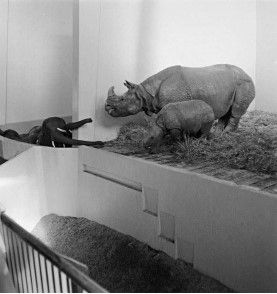
GOH rhinos next to elephants at Zoo Basel
Individual Holding (per rhino) Exhibit Only (per rhino) Breeding/Communal
Indoor Outdoor Indoor Outdoor Indoor Outdoor
30 sq. m 186 sq. m 215 sq. m 929 sq. m Not 2,787 sq. m
(320 sq ft) (2,000 sq. ft) (2,320 sq. ft) (10,000 sq. ft) Recommended (30,000 sq. ft)
Table 4.12. Recommended enclosure types and sizes for zoo-housed rhinos by species [in sq m and (sq ft)].


